
Foundation Crack Repair in Converse, TX
A crack is a clue, not a verdict. Crack work is often where Foundation Repair in Converse, TX begins, and the first job is telling ordinary shrinkage from real movement before anything gets sealed.
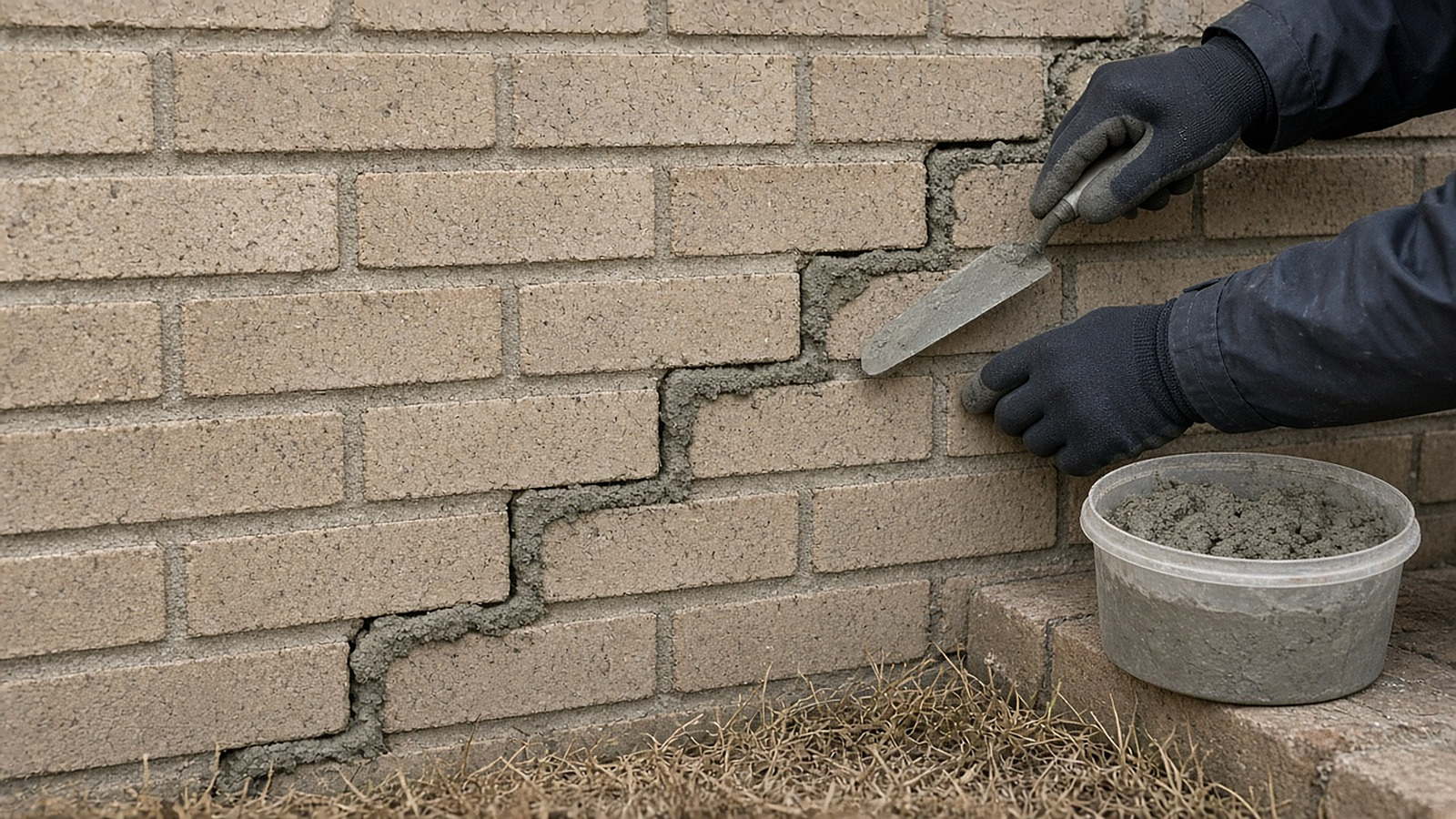
Repointing fills a stair-step crack with fresh mortar once the movement behind it is handled.
Route summary
Cracks in slabs, stem walls, brick and stone
Reading the crack, then injection, routing and sealing, or repointing
A crack wider at one end, offset, or one that came back
A photo with a coin for scale, then a call
What Does Foundation Crack Repair in Converse, TX Cover?
Cracks in three places: the concrete slab, the foundation or stem wall, and the brick or stone on the outside with its mortar. Each is repaired differently, and each is checked first for ongoing movement, because a crack sealed over a house that is still moving tends to open again.
Cracks in residential buildings occur across distinct structural components, and each material reacts differently to soil pressures. Concrete slabs bear compressive building loads and often show hairline drying cracks along room partitions. Foundation stem walls and poured perimeter grade beams resist lateral earth pressures and support framing, so cracks there demand careful evaluation of shearing forces.
Meanwhile, exterior brick veneer and limestone cladding are brittle non-structural facades anchored with metal ties. When the concrete foundation moves even a fraction of an inch, the rigid masonry joints above cannot bend, fracturing in stair-step lines along mortar beds. Attempting to seal any of these materials without verifying whether the foundation footing is still actively shifting will simply cause the sealant or fresh mortar to fail. A technician confirms the method and price after an inspection.
CRACK DIAGNOSTICSWhich Cracks Are Cosmetic and Which Point to Movement?
Thin, even, vertical cracks in concrete are often shrinkage from curing. Stair-step cracks in brick or stone, cracks wider at one end, cracks where one side sits higher, sideways cracks in a foundation wall and cracks that keep growing point to movement and are worth an inspection.
| Crack | Often means | Usual next step |
|---|---|---|
| Hairline vertical in concrete | Normal curing shrinkage as excess moisture evaporates | Monitor with dates; seal if cosmetic or water-exposed |
| Stair-step in brick or stone mortar | Differential foundation grade beam settling beneath wall | Elevation survey, pier stabilization, then mortar repointing |
| Wider at one end | Rotational movement or a corner dropping relative to center | Evaluate footing depth and underpinning options |
| One side higher (vertical offset) | Structural grade beam shearing and independent settlement | Mechanical lifting and structural leveling prior to bonding |
| Sideways in a foundation wall | Lateral soil pressure or swelling clay pushing inward | Inspect exterior drainage, soil grading, and wall bracing |
| Came back after patching | Ongoing soil movement continuing beneath the previous repair | Perform full inspection to treat the subsoil cause |
Not sure what your crack is telling you?
Call with its width, direction and location. We will explain what that pattern usually means.
Which Repair Fits Which Crack?
Epoxy injection bonds a crack in concrete; polyurethane injection flexes and helps block water; routing and sealing suits surface cracks in a slab; repointing replaces cracked brick or stone mortar. When movement caused the crack, the movement is handled first, often with piers.
Epoxy Pressure Injection for Structural Concrete
High-strength structural epoxy is injected into dormant concrete fractures under controlled hydraulic pressure. Once cured, the epoxy restores monolithic tensile integrity, effectively welding the concrete faces together stronger than the original slab material.
Flexible Polyurethane Injection for Moisture Control
Hydrophobic polyurethane foam expands upon contact with moisture, filling deep voids and hairline micro-fractures through foundation stem walls. Its rubberized flexibility tolerates subtle seasonal expansion while providing a reliable barrier against water penetration.
Mechanical Routing and Elastomeric Sealing
Surface cracks across garage slabs or exposed patios are routed into clean V-shaped grooves to remove loose aggregate. Industrial-grade elastomeric sealant is then tooled flush to prevent water infiltration and stop debris from wedging into the opening.
Masonry Mortar Repointing
Cracked or deteriorated mortar joints in exterior brick and limestone veneer are raked out cleanly without damaging the masonry units. Fresh, color-matched mortar is packed firmly into the joints, sealing the weather barrier and restoring structural facade appearance.
Why Does the Movement Come Before the Sealant?
A crack is a symptom. If the clay under that corner is still swelling and shrinking, a sealed crack usually reopens, often right beside the repair. Supporting the foundation first and sealing afterward gives the repair a far better chance to last.
When expansive clay soils settle beneath a home, the structure flexes under immense torque. Cracks represent the relief of that physical stress. If you seal or patch an active crack while the foundation footing remains unsupported, ongoing ground shrinkage will simply reopen the fracture or force a new crack through the adjacent concrete.
By first underpinning the settled section with engineered piers, the building is lifted and stabilized against future movement. Only after the structure is solidly supported should epoxy, polyurethane, or mortar repointing take place. Minor crack sealing is roughly $250 to $800 per crack in national guides, while broader structural repair projects run roughly $2,200 to $8,100 in national cost guides. Texas811 is contacted at least two business days ahead of any digging. Some foundation work may need a city permit; rules differ by city, so the technician says whether one applies before work starts. A technician confirms the method and price after an inspection.
HOMEOWNER MONITORINGKeeping a Crack Log
Mark both ends in pencil with the date
Make a small, neat pencil tick mark at the exact terminating ends of the crack and write the current calendar date beside each point.
Photograph the crack beside a ruler or coin
Capture clear, well-lit close-up photos placing a coin or metric ruler directly across the widest point of the fracture for consistent visual scale.
Re-check after weather swings
Examine the pencil marks every few weeks, particularly following an extended dry summer spell or several days of soaking South Texas rainfall.
Note sticking doors and nearby trim gaps
Record whether adjacent interior doors begin to stick, latches fail to catch, or windows bind as the crack length or width changes over time.
Questions about foundation crack repair
Can I just caulk the crack in my brick?
+−
Applying exterior silicone or acrylic caulk into exterior masonry cracks merely masks the visual symptom for a short season. Caulk does not bond structural brickwork, fails to match existing textured mortar, and does nothing to stop ongoing differential soil settlement beneath the foundation footing. If movement continues, the crack easily pulls free.
Are cracks normal in a newly built house?
+−
Yes, newly poured concrete slabs and freshly laid masonry cure over several months, naturally producing microscopic hairline shrinkage cracks as moisture evaporates. These superficial hairline cracks are uniform, narrow, and remain stable. However, if cracks widen beyond a coin's edge or produce stair-step fractures through brick, active foundation movement is present.
Will injection keep water out of a wall crack?
+−
Expanding hydrophobic polyurethane resin injection is specifically engineered to stop subterranean water infiltration through foundation stem walls and slab cracks. When injected under pressure, it reacts with moisture to expand into a closed-cell gasket. While it forms an impermeable moisture barrier, it does not provide structural load support if settlement is active.
Why would a repaired crack open up again?
+−
A repaired concrete or masonry fracture reopens when the underlying soil movement that generated the original stress was never mechanically stabilized. Sealing a crack addresses only the cosmetic break; if expanding and contracting Blackland clay continues to tilt the grade beam beneath, the repair material will inevitably tear or fracture adjacent mortar.
Is there a crack width that always means trouble?
+−
No single measurement automatically indicates structural failure in isolation. Instead, technicians evaluate a combination of width, directional orientation, rate of seasonal expansion, and whether one edge sits vertically offset from the other. A pencil-thin hairline crack that grows over several months warrants an inspection just as much as a wider static separation.
Question not covered here? Call (830) 465-4708
Slab Foundation Repair
For homes poured straight onto the clay, with floor cracks, a low corner or doors out of square.
Pier and Beam Foundation Repair
For raised floors over a crawlspace that dip, bounce or lean as the piers below settle.
Foundation Piering and Leveling
For settled houses that need support carried down to firmer ground, then a careful lift.